| 2025年高考数学天津-20 |
|
2026-10-10 17:52:57 |
|
|
(16分)已知函数$f(x)=ax-(\ln x)^{2}$.
$(I)a=1$时,求$f(x)$在点$(1$,$f$(1)$)$处的切线方程;
(Ⅱ)$f(x)$有3个零点$x_{1}$,$x_{2}$,$x_{3}$,且$(x_{1} < x_{2} < x_{3})$.
$(i)$求$a$的取值范围;
$(ii)$证明:$(\ln x_{2}-\ln x_{1})\cdot \ln x_{3} < \dfrac{4e}{e-1}$.
〖答案〗(Ⅰ)$x-y=0$;(Ⅱ)$(i)(0$,$\dfrac{4}{{e}^{2}})$;$(ii)$证明见解析.
〖分析〗(Ⅰ)$a=1$时$f(x)=x-(\ln x)^{2}$,求出$f$(1)$=1$与$f\prime$(1),即可写出$f(x)$在点$(1$,$f$(1)$)$处的切线方程;
(Ⅱ)$(i)$由$f(x)=0$,得$a=\dfrac{{(\ln x)}^{2}}{x}$,设$g(x)=\dfrac{{(\ln x)}^{2}}{x}$,利用导数求出$g(x)$的极值点,画出函数$g(x)$的大致图象,结合图象求解即可;
$(ii)$由题意,$0 < x_{1} < 1 < x_{2} < e^{2} < x_{3}$,设$\ln x_{1}=t_{1}$,$\ln x_{2}=t_{2}$,$\ln x_{3}=t_{3}$,则$t_{1} < 0 < t_{2} < 2 < t_{3}$,代回方程由均值不等式得$t_{3}t_{2} < 4$,再证$t_{2}t_{3}-t_{1}t_{3} < \dfrac{4e}{e-1}$,分析得出$\dfrac{{t}_{3}}{{e}^{\dfrac{{t}_{3}}{2}}}\leqslant \dfrac{4}{e-1}$,构造函数$h(t)=\dfrac{{t}^{2}}{{e}^{\dfrac{t}{2}}}$,$t > 2$,求出$h(t)\leqslant \dfrac{16}{{e}^{2}}$,从而得出命题成立.
〖解答〗解:(Ⅰ)$a=1$时,$f(x)=x-(\ln x)^{2}$,且$f$(1)$=1$,$f\prime (x)=1-2\ln x\cdot \dfrac{1}{x}$,所以$k=f\prime$(1)$=1$,
所以$f(x)$在点$(1$,$f$(1)$)$处的切线方程为$y-1=1\times (x-1)$,即$x-y=0$;
(Ⅱ)$(i)$由$f(x)=0$,得$a=\dfrac{{(\ln x)}^{2}}{x}$,$x > 0$;
设$g(x)=\dfrac{{(\ln x)}^{2}}{x}$,则$g\prime (x)=\dfrac{2\ln x{-(\ln x)}^{2}}{{x}^{2}}=\dfrac{\ln x(2-\ln x)}{{x}^{2}}$,
令$g\prime (x)=0$,得$x=1$或$x=e^{2}$,
所以$x\in (0,1)$时,$g\prime (x) < 0$,$g(x)$单调递减,$g(x)\in (0$,$+\infty )$;
$x\in (1,e^{2})$时,$g\prime (x) > 0$,$g(x)$单调递增,$g(x)\in (0$,$\dfrac{4}{{e}^{2}})$;
$x\in (e^{2}$,$+\infty )$时,$g\prime (x) < 0$,$g(x)$单调递减,$g(x)\in (0$,$\dfrac{4}{{e}^{2}})$;
画出函数$g(x)$的大致图象,如图所示:
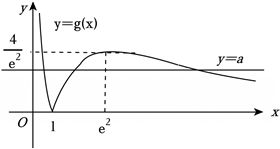
由函数的图象,结合题意知,$a$的取值范围是$(0,\dfrac{4}{{e}^{2}})$;
$(ii)$证明:由$(i)$知,$0 < x_{1} < 1 < x_{2} < e^{2} < x_{3}$,设$\ln x_{1}=t_{1}$,$\ln x_{2}=t_{2}$,$\ln x_{3}=t_{3}$,
则$t_{1} < 0 < t_{2} < 2 < t_{3}$,又$\left\{ \begin{array}{*{35}{l}}
a{{e}^{{{t}_{1}}}}=t_{1}^{2} \\
a{{e}^{{{t}_{2}}}}=t_{2}^{2} \\
a{{e}^{{{t}_{3}}}}=t_{3}^{2} \\
\end{array} \right.$,由②③得$\left\{\begin{array}{l}{\ln a{+t}_{2}=2l{nt}_{2}}\\ {\ln a{+t}_{3}=2l{nt}_{3}}\end{array}\right.$,两式相减得$t_{3}-t_{2}=2(\ln t_{3}-\ln t_{2})$,
由对数均值不等式得$2=\dfrac{{t}_{3}{-t}_{2}}{l{nt}_{3}-l{nt}_{2}} > \sqrt{{t}_{3}{\cdot t}_{2}}$,所以$t_{3}t_{2} < 4$;
要证$(\ln x_{2}-\ln x_{1})\ln x_{3} < \dfrac{4e}{e-1}$,即证$t_{2}t_{3}-t_{1}t_{3} < \dfrac{4e}{e-1}$,
只需证$4-t_{1}t_{3}\leqslant \dfrac{4e}{e-1}$,即证$-t_{1}t_{3}\leqslant \dfrac{4}{e-1}$,
又因为$t_{1} < 0$,$0 < {e}^{{t}_{1}} < 1$,所以${t}_{1}^{2}=a{e}^{{t}_{1}} < a$,所以$\vert t_{1}\vert =-t_{1} < \sqrt{a}$,
所以$-t_{1}t_{3} < \sqrt{{at}_{3}^{2}}=\dfrac{{t}_{3}^{2}}{{e}^{\dfrac{{t}_{3}}{2}}}$,只需证$\dfrac{{t}_{3}^{2}}{{e}^{\dfrac{{t}_{3}}{2}}}\leqslant \dfrac{4}{e-1}$;
设$h(t)=\dfrac{{t}^{2}}{{e}^{\dfrac{t}{2}}}$,$t > 2$,则$h\prime (t)=\dfrac{2{te}^{\dfrac{t}{2}}-{{\dfrac{1}{2}t}^{2}e}^{\dfrac{t}{2}}}{{e}^{t}}=\dfrac{(2-\dfrac{1}{2}t)t}{{e}^{\dfrac{t}{2}}}$,
当$2 < t < 4$时,$h\prime (t) > 0$,$h(t)$在$(2,4)$上单调递增;
当$t > 4$时,$h\prime (t) < 0$,$h(t)$在$(4,+\infty )$上单调递减;
所以$h(x)_{max}=h$(4)$=\dfrac{16}{{e}^{2}}$,即$h(t)\leqslant \dfrac{16}{{e}^{2}}$,
由$4e^{2}-16e+16=4(e-2)^{2} > 0$,得$\dfrac{16}{{e}^{2}} < \dfrac{4}{e-1}$成立,命题得证.
〖点评〗本题考查了导数的综合应用问题,也考查了函数的零点与不等式的证明,是难题.
|
|
http://x.91apu.com//shuxue/gkt/2025/2025tj/2026-10-12/34615.html |